While my teaching fosters connection, my research investigates authority, namely, how language produces and legitimizes power in the public sphere. My work examines the discursive processes that give ideologies their shape and force, as well as those that make particular power relations appear credible and natural. To explore these questions, I integrate social, cognitive, and quantitative approaches to understand how language configures social realities.
My current project examines how contemporary state and diplomatic rhetoric constructs ideological alignment and legitimizes particular visions of political order. Analyzing US state discourse from 2025 to the present both qualitatively and quantitatively, the project investigates how transactional logic and sovereigntist values polarize long-standing alliances like NATO. By examining how member states at NATO’s eastern edge are positioned as either axiologically proximate or distant, the work reveals how alliance solidarity is increasingly redefined as conditional on ideological alignment rather than guaranteed by institutional membership. I will present this work in November 2026 at the DN34 International Conference on Discourse, Identity and Polarisation at Vilnius University, Lithuania.
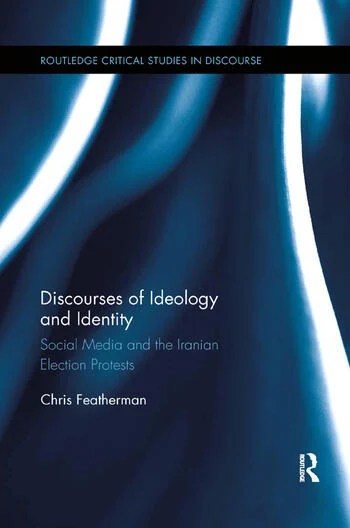
My book Discourses of Ideology: Social Media and the Iranian Election Protests (Routledge, 2018) traces how social movement ideologies and identities are reembedded across media platforms. Grounded in a sociocognitive approach to critical discourse analysis, it examines written and visual texts to show the ways that actors position themselves and become positioned, discursively and symbolically, within a dynamic ideological field. The book also shows how activists’ tactical communicative practices across social media platforms were taken up in Western legacy media as evidence of ideological alignment, shaping broader narratives about counter‑power, globalization, and activist identity.
I explore similar themes in the essays on the Writing page.